
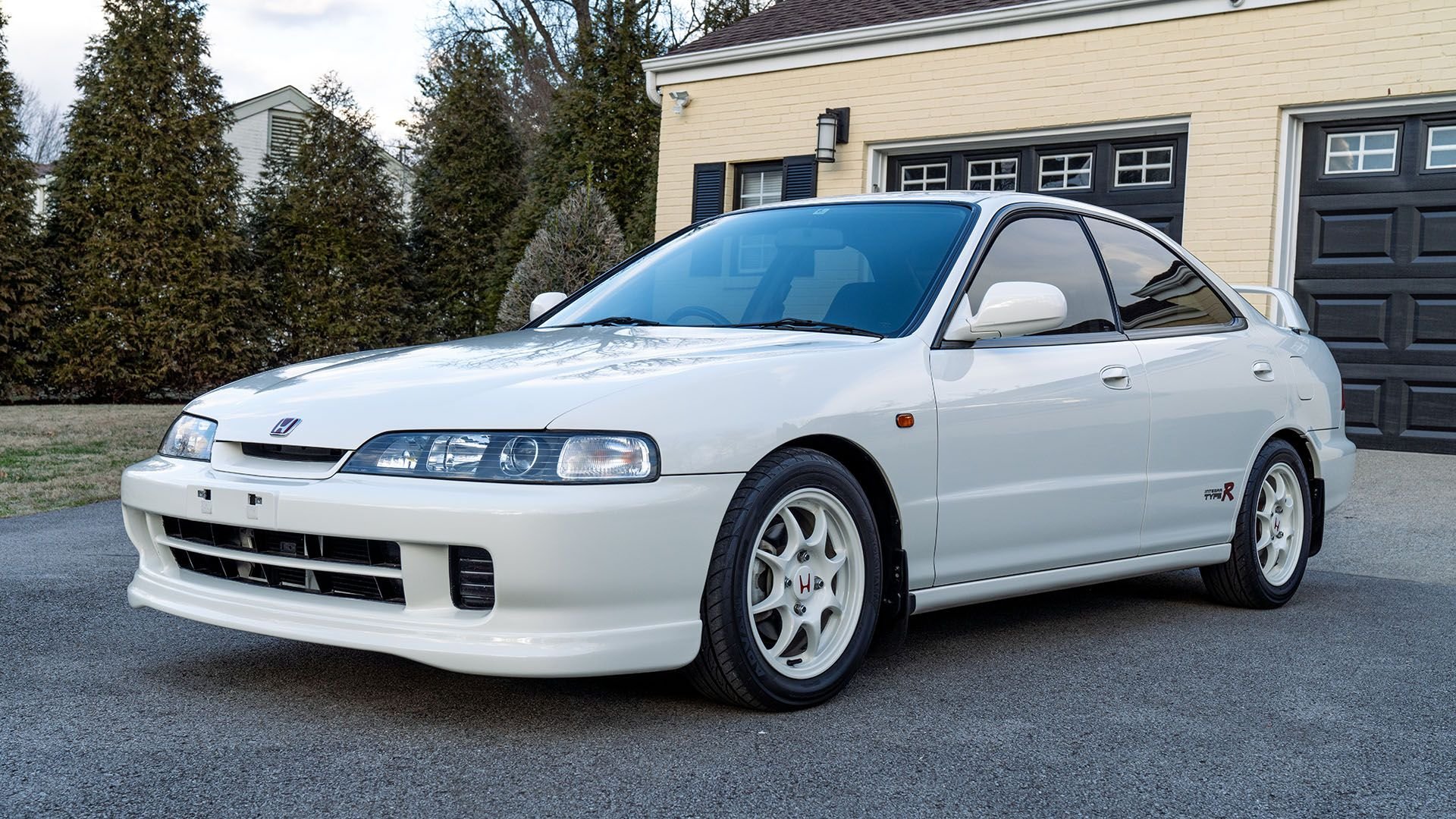
Integra Type R
Honda's Mission
Honda’s goal with the Integra DC2 was to refine the Civic formula into a more focused, performance-oriented compact car. It emphasized high-revving VTEC engines, sharper handling, and a stiffer, more balanced chassis to deliver precise, engaging driving without sacrificing everyday usability.
With the DC2 Type R, Honda pushed this idea further by stripping weight, reinforcing the chassis, shortening gearing, and fine-tuning suspension and steering response. Every part was optimized for driver feedback and cornering performance, creating a car built almost entirely around precision, balance, and high-revving engagement.
The History
Performace
The B18C5 in the Type R produced around 197 hp, but its real strength was its 8,400+ rpm redline and close-ratio 5-speed gearbox that kept the engine in its narrow power band. A helical limited-slip differential helped manage traction under load, especially during corner exit, while the lightweight chassis kept curb weight near the one-ton mark in stripped versions. The result was a car that could carry exceptional speed through corners rather than relying on straight-line acceleration.
Technology
The DC2 Integra showcased Honda’s engineering shift toward high-efficiency performance through advanced engine and chassis design. At its core was the B-series DOHC VTEC system, using variable valve timing and lift to combine low-end drivability with high-RPM power delivery. The chassis used a rigid unibody structure with extensive spot welding in higher trims, while suspension geometry focused on maximizing camber control and reducing torque steer.
Legacy
Widely regarded as one of the purest front-wheel-drive performance cars ever made. Its reputation was built on its balance of simplicity, high-revving character, and surgical chassis response, often outperforming more powerful rivals on technical roads and circuits. It set a benchmark for lightweight, naturally aspirated engineering and influenced later Honda performance models, including the Civic Type R lineage. Today, it remains a reference point in enthusiast circles for what a focused, analog driver’s car should feel like.
The DC2 Integra was developed in the early 1990s by Honda’s in-house engineering teams in Japan to push the model into a more performance-focused compact. Led by chassis and powertrain engineers, it emphasized precise tuning, with the Type R reflecting Honda’s hand-built approach—engines carefully assembled and balanced by skilled technicians for maximum response. Key figures like Shigeru Uehara helped shape Honda’s performance direction during this period.
Its legacy comes from Honda Motor Co.’s fully internal approach to engineering, allowing complete control over the chassis, gearing, and high-revving VTEC development. This resulted in a car that defined Honda’s identity at its peak and set a benchmark for front-wheel-drive performance.
Quirks and Features

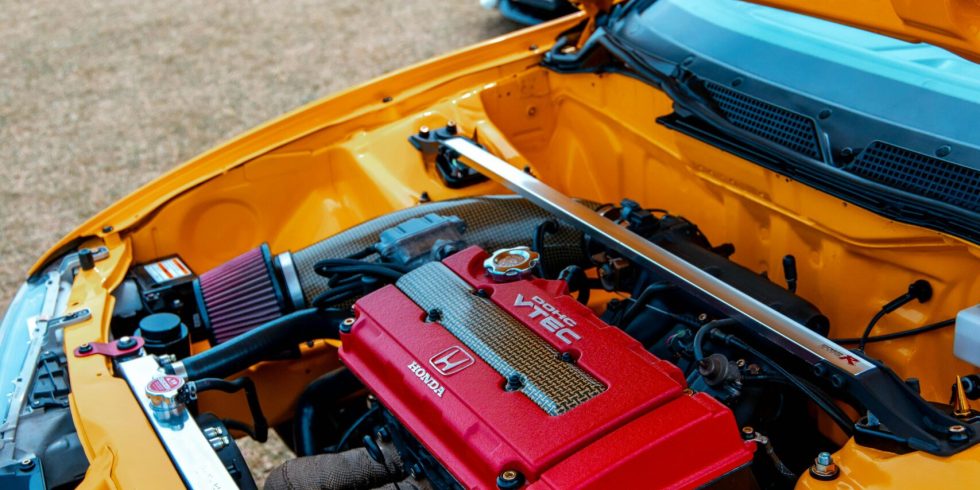
High-Revving Engine (B18C5)
Each Type R engine was individually blueprinted and balanced, with ported heads, high-compression internals, and a VTEC system tuned for aggressive high-RPM engagement. It wasn’t just powerful for its size—it was designed to feel alive above 6,000 rpm and keep pulling all the way to its 8,000+ rpm redline.

Iconic “Four-Eye” Headlights
The DC2 Integra Type R’s fixed four-headlight “bug-eye” front end became one of its most defining features. Unlike pop-up headlights, this setup reduced weight and mechanical complexity while giving the car a more aggressive, functional look. It also improved airflow and durability, helping reinforce its no-nonsense, track-focused identity.
Track-Focused Gearbox and Limited-Slip Differential
The close-ratio 5-speed transmission was specifically geared to keep the engine in its narrow power band, while the helical LSD improved traction out of corners. This made the car feel exceptionally direct and precise, especially in technical driving where maintaining momentum mattered more than raw power.
